
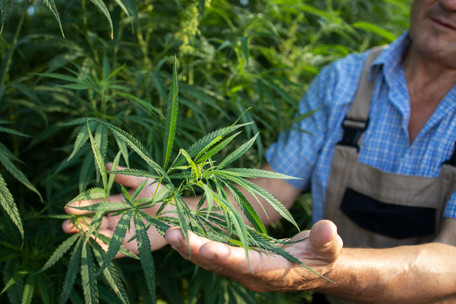
Why Doesn't Hemp Get You High? The Real Science
Posted by Colorado Cures on Sep 14th 2026
Somewhere around the third time a customer asks us this question in a single afternoon, we start to appreciate how strange the whole situation must look from the outside. Hemp and marijuana are the same plant. Same genus, same species, same leaf shape everyone learned to recognize in ninth grade. Yet one of them is sold next to essential oils and bath bombs, and the other requires a very different kind of storefront. If you've ever paused in our aisle wondering how that's possible, you're asking a better question than you probably realize.
The short version involves a courtroom-precise legal threshold, a compound your body already makes on its own, and a receptor in your brain that one cannabinoid barely bothers to knock on. Here's the whole picture, no chemistry degree required.
The Short Answer
Hemp doesn't get you high because federal law defines it, and growers breed it, to contain no more than 0.3% delta-9 THC by dry weight, the compound responsible for cannabis intoxication. What hemp is grown to deliver instead is CBD, a cannabinoid that interacts with the body's endocannabinoid system without triggering the same effect on the brain. Same plant family, different chemistry, different legal category entirely.
Hemp and Marijuana Split at a Single Number
Here's the part that surprises most people: there is no botanical line between hemp and marijuana. Pull up a plant taxonomy and you won't find two separate species waiting to be told apart. Both are Cannabis sativa. The distinction the law draws is chemical, not biological, and it comes down to one number.
Under the 2018 Farm Bill, hemp is legally defined as cannabis containing 0.3% delta-9 THC or less, measured by dry weight. Cross that threshold and the same plant is legally marijuana, regulated at the state level in an entirely different framework. It's less like comparing two different fruits and more like the difference between orange juice and orange juice that's been left out fermenting a little too long. Related. Not interchangeable. And the government cares exactly where that line falls.
Hemp farmers select for this on purpose. Decades of selective breeding have pushed hemp genetics toward high CBD content and low THC content, the opposite priority of marijuana cultivation. By the time a hemp plant reaches a processor, it was never on track to cross 0.3% THC in the first place. The law didn't just draw a line. It shaped what gets planted on one side of it.
What Actually Makes a Cannabinoid Psychoactive
Cannabis plants produce over a hundred different cannabinoids, but almost all of the public conversation about getting high centers on one of them: delta-9 THC. THC produces intoxication because of how tightly it binds to CB1 receptors, which are concentrated in the brain and central nervous system. That binding is what triggers the altered perception, the shift in mood, the effects people associate with being high.
CBD is built differently at the molecular level, and that difference matters more than a single letter swap in the name suggests. CBD has a low binding affinity for CB1 receptors. It interacts with the endocannabinoid system through other pathways entirely, and in some research, it appears to actually blunt THC's effect on those same receptors rather than amplify it. That's the chemical reason a hemp-derived CBD product and a THC-dominant product can come from the same plant family and land in completely different categories of experience.
None of this is marketing language. It's pharmacology, and it's the same reasoning the Farm Bill leaned on when regulators needed a workable, measurable line between a fiber and wellness crop and a controlled substance.
Wait, Isn't Some Hemp Supposed to Get You High?
Good catch, and worth addressing directly instead of dancing around it. In recent years, chemists learned to convert hemp-derived CBD into other cannabinoids, including delta-8 THC and THCP, both of which do produce intoxicating effects and are technically legal under the same 0.3% delta-9 THC framework, since that threshold only measures one specific cannabinoid. That loophole is real, and it's why "hemp" as a legal category has gotten more complicated than it was even a few years ago.
Here's what that means for you as a shopper: the word "hemp" on a label tells you about the plant's legal origin, not automatically whether a product is intoxicating. What tells you that is the actual cannabinoid panel. A CBD-dominant hemp product built the way ours are, with delta-9 THC kept under the legal threshold and no added delta-8 or THCP, isn't going to produce a high. A hemp-derived product engineered around one of those other cannabinoids is a different category of product entirely, and a responsible retailer should never make you guess which one you're holding.
How We Keep Every Batch On the Right Side of the Line
We don't ask you to take our word for where our products land on any of this. Every batch we sell is sent to an independent lab, and the resulting Certificate of Analysis breaks down exactly which cannabinoids are present and in what amount, delta-9 THC included. You can scan the QR code on the package or pull up results directly on our Colorado Cures Lab Results page before you ever open the bottle.
This is also where our CO2 extraction process earns its keep. Rather than relying on harsh solvents that can leave residue behind, we extract using pressurized carbon dioxide, a method that preserves the plant's natural cannabinoid and terpene profile while keeping the process clean and controllable batch to batch. Controllable is the operative word. It's a large part of how a hemp product stays consistently, verifiably under 0.3% THC instead of hoping for the best.
Frequently Asked Questions
Why doesn't hemp get you high?
Hemp is legally defined as cannabis containing 0.3% delta-9 THC or less by dry weight, the specific cannabinoid responsible for intoxication. Hemp is also bred to be high in CBD, which does not produce the same effect on brain receptors that THC does, so properly grown and processed hemp products don't cause a high.
Is CBD psychoactive?
CBD affects the body, which technically makes it psychoactive in the broadest sense, similar to how caffeine is. It is not intoxicating. It does not impair coordination, judgment, or perception the way THC does, because it doesn't bind strongly to the CB1 receptors that drive that effect.
What's the actual difference between hemp and marijuana?
There is no botanical difference. Both are Cannabis sativa. The legal difference is entirely chemical: hemp contains 0.3% delta-9 THC or less by dry weight, while marijuana exceeds that threshold. Cultivation practices then reinforce the split, with hemp bred for low THC and high CBD.
Can hemp products still contain THC?
Yes, in small amounts. Legal hemp products can contain up to 0.3% delta-9 THC by dry weight and still qualify as hemp. That trace amount is far below what's needed to produce a high, which is why lab testing every batch matters more than trusting a label alone.
Are all hemp products non-intoxicating?
No, and this is the part worth remembering. Some hemp-derived cannabinoids, including delta-8 THC and THCP, are intoxicating even though they're processed from legally compliant hemp. The word "hemp" describes a plant's legal status, not automatically its effect. Always check the actual cannabinoid panel on a product's Certificate of Analysis rather than assuming based on the word on the front of the label.
The Short Version
Hemp and marijuana aren't two different plants. They're the same plant sorted by a single number, 0.3% delta-9 THC, and everything else follows from there: what gets bred, what gets extracted, and what shows up on a lab report. CBD doesn't get you high because it isn't built to grab hold of the receptors that produce that effect, not because someone decided to leave something out. And because "hemp" alone doesn't guarantee non-intoxicating anymore, the only real answer to what's in your bottle is the one printed on its Certificate of Analysis. Scan it, read it, and you'll never have to wonder.